

Rockstar Games has always understood music differently than most game studios.
For decades, Grand Theft Auto has used radio stations, curated soundtracks, DJs and fictional nightlife to make its open worlds feel alive. Music in GTA is not just background audio. It helps define the city, the culture, the driving experience and the way players remember the world after they leave it.
That’s why Rockstar’s partnership with CircoLoco deserves more attention.
CircoLoco Records, the joint label from Rockstar Games and CircoLoco, launched in 2021 as a bridge between one of gaming’s most influential studios and one of dance music’s most respected party institutions. At the time, it looked like a smart culture play. Now, with GTA VI bringing the series back to Vice City for one of gaming and entertainment’s most anticipated releases of 2026, and with CircoLoco Records building momentum through artists like PAWSA, Prospa, Mochakk and Carlita, the genius of the project is becoming much clearer.
More than just a label partnership, Rockstar x CircoLoco Records shows how gaming can become a new path for dance music discovery.
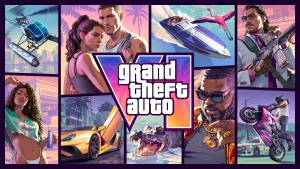
Rockstar has not officially announced a CircoLoco Records radio station for GTA VI, but the connection is hard to ignore. GTA Online already turned real DJs, underground clubs and dance music radio into playable culture. CircoLoco Records gave Rockstar a direct pipeline into house and techno. Outlined on GTA VI’s official website, Rockstar’s next open world already includes artists, labels, studios and music-business ambition through Only Raw Records, a fictional label tied to Vice City’s music scene. Together, those pieces point toward something obvious: Rockstar has been building the music infrastructure for its next era.
Rockstar has been quietly building dance music into GTA
CircoLoco Records didn’t appear out of nowhere. By the time Rockstar and CircoLoco launched the label, Rockstar had already spent years turning dance music into an interactive part of Grand Theft Auto.
GTA V’s original radio ecosystem included stations like FlyLo FM, Soulwax FM and Worldwide FM, giving Los Santos a strong electronic, underground and club-adjacent identity alongside hip-hop, pop, rock, funk, soul and talk radio. FlyLo FM, curated by Flying Lotus, became one of the game’s most important artist-led stations, while Soulwax FM gave GTA V a direct connection to house, techno and electronic music culture.

That strategy became even more explicit in GTA Online. In 2018, Rockstar launched After Hours, an update that let players open and operate their own nightclub with real-world resident DJs including Solomun, Tale Of Us, Dixon and The Blessed Madonna. These artists were not only soundtracking the update. Their likenesses were integrated into the game, and players could book them into their clubs as part of the nightlife system.
Rockstar expanded the idea again with The Music Locker, the underground club introduced during GTA Online’s Cayo Perico era. That rollout brought Moodymann, Keinemusik and Palms Trax into Los Santos, while Music Locker Radio extended the club’s sound into the game’s wider radio ecosystem.
That history is important because it shows Rockstar was already thinking beyond traditional sync licensing. The company was not just placing songs into a game. It was building systems around DJs, radio stations, club spaces, artist discovery and player identity. CircoLoco Records was the next logical step: a real-world label that could feed into Rockstar’s virtual worlds.
How Rockstar and CircoLoco came together
The backstory behind CircoLoco Records is one of the most important parts of the label’s identity.
This was not a random corporate partnership. CircoLoco Records grew out of the relationship between Rockstar founder Sam Houser and CircoLoco promoter Antonio Carbonaro. Carbonaro has described the project as being born from his friendship with Houser and their shared passion for music, with the original idea forming around a Miami event between the two brands in 2019 before taking shape during the pandemic.
That origin gives the label a different kind of credibility. It was not simply Rockstar trying to attach itself to dance music because house and techno were trending. It came from two culture-first brands that already understood each other.
CircoLoco had spent more than two decades building one of the most respected underground party brands in the world. Its home at DC10 in Ibiza made it a global reference point for house and techno, while its international events helped turn the brand into a worldwide club institution. Rockstar, meanwhile, had built one of the most important music platforms in gaming through GTA radio, artist-led stations and in-game nightlife.
That Ibiza foundation also gives CircoLoco a unique pulse on dance music talent. Every summer, Ibiza becomes one of the most important meeting points for house and techno, pulling together DJs, producers, agents, promoters, labels and fans from across the UK, Europe and beyond. For a label like CircoLoco Records, that position is valuable. It keeps the brand close to the artists breaking through in real time, not just the names already established on global festival lineups.
Together, the two companies had a clear overlap. CircoLoco brought real-world underground authority. Rockstar brought global scale, gaming infrastructure and one of the most powerful music discovery platforms in entertainment.

The launch: Monday Dreamin’
CircoLoco Records launched with a statement project.
Its first major release was Monday Dreamin’, a 20-track compilation featuring new music from artists connected to CircoLoco’s history and community. Rockstar described the project as the debut compilation from CircoLoco Records, built around the label’s connection to global club culture.
Before the full compilation arrived, the label rolled the project out through EPs, beginning with Monday Dreamin’ Blue. That first release featured Seth Troxler, Kerri Chandler, Dixon, Rampa and Sama’ Abdulhadi, immediately giving the label serious underground weight.
The full Monday Dreamin’ project expanded the world further with names including Tale Of Us, Dixon, Sama’ Abdulhadi, Kerri Chandler, tINI and more.
That launch strategy was smart. Rather than entering the market with a single crossover record, CircoLoco Records started by making a statement about community. The compilation format let the label reflect different eras of CircoLoco’s history while positioning Rockstar as more than a licensing partner. Rockstar was now helping release new dance music directly.
From there, the label gradually moved into singles, EPs and artist-led projects.
From Ibiza legacy to modern club records
The most interesting part of CircoLoco Records is how the label has evolved.
Monday Dreamin’ established the foundation with legacy credibility. The newer catalog shows the label becoming a home for current club records, rising stars and artists sitting closer to the present-day center of house, tech-house and global dance music.
That shift is clear across releases from PAWSA, Prospa, Josh Baker, Mochakk, Carlita, Jimi Jules, Skream, Sparrow & Barbossa, Hiver and more. CircoLoco Records’ catalog currently includes Prospa’s Free Your Mind, Jimi Jules’ Baby Run, Skream’s “The Boy / Moon,” Prospa and Josh Baker’s “You Don’t Own Me,” PAWSA’s “COLLECT THE COMMAS” and Mochakk’s Locomotiva Ibiza 2099 projects.
That is where the label becomes especially relevant to GTA VI. This is not just a nostalgic Ibiza project. CircoLoco Records is actively releasing music from artists who matter in today’s house and techno landscape.
PAWSA and the current tech-house wave
PAWSA is one of the most important names in the label’s newer era.
His 2024 single “COLLECT THE COMMAS” arrived on CircoLoco Records at a moment when PAWSA was becoming one of the defining names in modern tech-house. The track also gave the label a charting record under its own name, reaching No. 34 on the Official Singles Sales Chart and No. 31 on the Official Singles Downloads Chart.
PAWSA is key because he represents a different kind of success for CircoLoco Records. The label is not only releasing respected underground names or legacy club figures. It is also getting behind artists who are moving the current dance market, with records that can travel across festivals, clubs, streaming platforms and charts.
For Rockstar, that kind of artist relationship is valuable. It gives the company relevance in the current club conversation, not just access to catalog music after the fact.
Prospa as the label’s breakout story
Prospa may be the clearest example of CircoLoco Records developing from a respected imprint into a more active artist platform.
The UK duo has become one of the label’s most consistent acts, with releases including “This Rhythm” with RAHH, “Don’t Stop,” “You Don’t Own Me” with Josh Baker and RAHH, “Love Songs,” “Free Your Mind” and “Baby.” In 2026, CircoLoco Records released Prospa’s debut album Free Your Mind, giving the label one of its most complete artist-led projects so far.
The chart data supports Prospa as a real success story. “You Don’t Own Me” by Prospa, Josh Baker and RAHH reached No. 94 on the Official Singles Chart, No. 21 on the Official Singles Sales Chart and No. 19 on the Official Singles Downloads Chart.
Those are meaningful results for a label positioned around underground club music. They show CircoLoco Records can live inside credible dance culture while still producing records that move through broader commercial channels.
Prospa also shows the mutual benefit of the partnership. CircoLoco Records gives the artist underground credibility and label identity. Rockstar gives the release a larger cultural frame and a potential long-term connection to gaming audiences.
The New House Wave Around CircoLoco Records
Beyond PAWSA and Prospa, the label’s roster shows how wide the CircoLoco Records lane has become.
Josh Baker’s role on You Don’t Own Me connects the label to the UK house scene, where he has been part of a new wave of producers translating club credibility into wider momentum. The track’s chart performance gives that collaboration a measurable commercial story, not just a tastemaker one.
Mochakk brings a different kind of energy. His Locomotiva Ibiza 2099 projects placed one of dance music’s most exciting new-generation global stars inside the CircoLoco Records catalog, giving the label a younger, internet-native and internationally visible presence. Beatportal also highlighted Mochakk’s “Jealous” as part of the label’s real-world release momentum beyond its GTA connection.
Carlita adds another dimension. Her presence connects the label to a stylish, melodic and fashion-adjacent side of house music, which fits both CircoLoco and a game world like GTA. Rockstar’s fictional cities are built on scenes, characters, spaces and aesthetics. Artists like Carlita help the label feel broader than peak-time club tools.
Jimi Jules’ Baby Run and “Turbo Rosso” continued the label’s recent activity, showing that CircoLoco Records is still actively building its catalog during the same window GTA VI is moving toward release.
Together, these names highlight CircoLoco Records’ importance beyond one label catalog. It sits at the center of a larger house music ecosystem: established underground credibility, current club records, rising new-generation artists and the kind of sound that could translate directly into GTA VI’s clubs, radio stations and post-launch artist integrations.
Why the partnership benefits Rockstar
For Rockstar, CircoLoco Records creates a direct line into credible dance music.
That makes sense if you know GTA has always used music to make its worlds feel culturally current. A GTA radio placement can turn a song into part of a player’s memory. An in-game nightclub can make a DJ feel like part of the city. A station can introduce millions of players to sounds they may not find through traditional streaming playlists.
CircoLoco Records gives Rockstar more control over that process. Instead of only licensing finished tracks, Rockstar can help build a catalog, develop relationships with artists and promote releases through its own media ecosystem. That creates a music pipeline that can feed radio stations, trailers, in-game clubs, online updates and future artist integrations.
It also gives Rockstar credibility in underground club culture. GTA’s scale is massive, but scale alone does not create taste. CircoLoco gives Rockstar access to a brand that has spent decades building trust with DJs, producers and serious dance music fans.
For Rockstar, that Ibiza connection is especially valuable because CircoLoco is not just licensing from the outside; it is embedded in one of the main summer circuits where house and techno talent is discovered, tested and amplified.
That is especially useful for GTA VI. Vice City is a Miami-inspired world, and Miami is naturally tied to nightlife, radio, dancefloors, cars, beach culture and electronic music. If Rockstar wants GTA VI to feel musically current, CircoLoco Records gives it one of the cleanest possible routes into house and techno.
Why the partnership benefits CircoLoco
For CircoLoco, the partnership offers scale most underground brands cannot access on their own.
CircoLoco already had global credibility before Rockstar entered the picture. What Rockstar brings is reach. GTA is not a normal media platform. Players spend hours inside its world, hearing songs while driving, entering clubs, completing missions and building social memories around the music.
That kind of discovery is powerful. A CircoLoco Records release can exist on streaming platforms and in DJ sets, but it can also potentially live inside one of gaming’s biggest cultural ecosystems.
The partnership also helps CircoLoco expand beyond events. A party brand depends on cities, venues, lineups and calendars. A label creates catalog value. It gives CircoLoco a recorded-music business that can continue building between shows, while keeping the brand active in the global dance conversation.
For artists, the value is clear too. A CircoLoco Records release carries underground credibility, but the Rockstar connection gives it a larger cultural ceiling. That combination is rare.
How this relates to GTA VI
This is where the partnership connects most directly to Rockstar’s future.
GTA VI is currently set to launch on November 19, 2026 for PlayStation 5 and Xbox Series X|S. The game returns to Vice City and the wider state of Leonida, a fictionalized Florida setting where music, nightlife, social media, cars, crime, fame and local culture are already being positioned as central parts of the world.
Rockstar’s official GTA VI materials already include Only Raw Records, a fictional music label tied to aspiring music mogul Dre’Quan Priest and Vice City personality Boobie. Rockstar describes their partnership as being focused on building Only Raw Records and finding a hit, which confirms that labels, artists, studios and music-business worldbuilding are already part of GTA VI’s identity.
That is exactly why CircoLoco Records feels relevant.
Rockstar has not announced GTA VI radio stations yet, and it has not confirmed a CircoLoco Records station. But GTA’s history makes the direction clear. Rockstar has already used artist-curated radio, real-world DJs, in-game clubs and underground dance spaces as part of GTA Online. CircoLoco Records gives the company an owned house music pipeline at the exact moment it is returning to Vice City.
A dedicated CircoLoco Records radio station would make sense. So would a broader house and techno station featuring CircoLoco artists, guest mixes or label catalog records. The label could also fit naturally into in-game clubs, beach parties, luxury nightlife spaces, street racing scenes or post-launch GTA Online-style updates.
The bigger implication is artist discovery. GTA VI will likely be one of the biggest entertainment launches of the decade. Any artist placed inside that world could reach an audience far beyond traditional dance music channels. For house and techno artists, that kind of exposure can be massive because it does not feel like a passive ad placement. Players discover music while living inside the world.
That is the power of gaming as a music discovery platform.
A song heard in GTA is not just another playlist add. It becomes connected to a city, a car, a mission, a nightclub, a character or a specific moment. That emotional context is why GTA radio has stayed culturally important for so long.
CircoLoco Records is more than a side project
CircoLoco Records started as a friendship-driven collaboration between Rockstar and CircoLoco, built during a difficult period for dance music. It launched with Monday Dreamin’, a 20-track compilation honoring CircoLoco’s history, then evolved into a label releasing relevant singles, EPs and albums from artists shaping the current house music landscape.
Now, with GTA VI on the horizon, the label looks like one of Rockstar’s smartest long-term music plays.
CircoLoco gives Rockstar credibility in underground club culture. Rockstar gives CircoLoco access to one of the biggest entertainment platforms in the world. Artists get a release pathway that can move between clubs, streaming platforms, charts and potentially gaming.
That is why CircoLoco Records feels bigger than a label partnership. It is a model for how dance music can move through gaming without losing its cultural roots.
And if GTA VI follows the path Rockstar has already been building, CircoLoco Records may become one of the clearest examples yet of artist discovery through gaming.
Not to mention GTA VI already surpassing billions in presales ahead of its November release.
Learn more about CircoLoco Records