
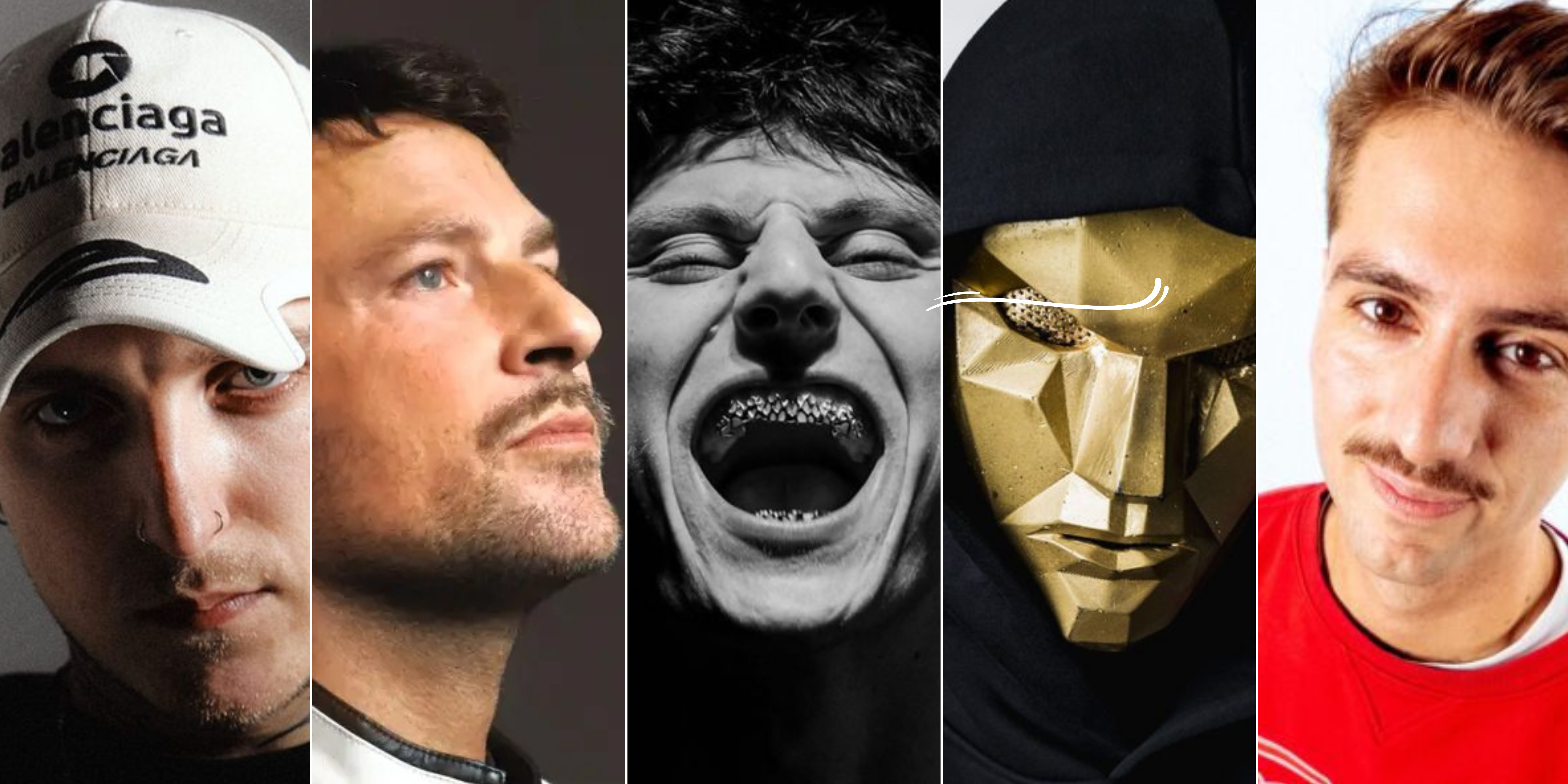
Hard techno has always loved a bit of darkness — dim warehouses, pounding kicks, silhouettes moving at 150 BPM like it’s cardio with a strobe light. But this week, the mood shifted. The shadows aren’t aesthetic anymore. They’re uncomfortable.
A series of sexual abuse and misconduct allegations have surfaced online against several prominent names in the hard techno circuit, sending the scene into a rapid, very public recalibration. The accusations involve artists including Shlømo, Basswell, Fantasm, CARV, and Odymel. The claims gained traction when former booking agent Brad — known online as @bradnolimit — publicly accused multiple artists within the scene of sexual misconduct, including sexual abuse, grooming of underage girls, and sexual assault.
The accusations have since been echoed and examined by outlets including DJ Mag Germany and Change-Underground, amplifying both their reach and their severity. As of now, these remain allegations. No publicly confirmed criminal convictions have been announced in connection with the claims, and any investigations — legal or otherwise — are ongoing or unconfirmed. That distinction matters. In 2026, however, consequences cannot outrun the speed of the internet.
Multiple festivals and event brands have moved swiftly to remove artists from upcoming lineups amid what organizers have described as “serious allegations.” Among them: Verknipt, World Club Dome, Open Beatz, Airbeat One, Teletech, and Doof Music.
In Instagram statements, organizers emphasized that while they are not in a position to make legal judgments, community safety, trust, and well-being take top priority. Verknipt confirmed that Basswell, CARV, and Shlømo would no longer appear at upcoming events. World Club Dome reiterated that its festival is intended to be a space where consent, respect, and equality are “actively upheld.”
The cancellations continue to stack up. Indian promoter Subvolt pulled a scheduled Shlømo appearance. Germany’s Das Zimmer Mannheim canceled CARV. Chile’s Respira Festival removed both Shlømo and Basswell. Malta’s Glitch Festival confirmed Odymel would no longer appear at its 2026 edition following an internal review.
In electronic music, reputation is currency — and it fluctuates fast.
The controversy has also rippled through Steer Management, the French agency where Brad claims to have previously worked. Over the weekend, Steer confirmed it had suspended collaborations with Shlømo, Basswell, and CARV. Shortly after, multiple artists formerly on its roster — including DJ Physical, alt8, Lola Cerise, 6EJOU, Creed, and William Luck — announced their departures via social media.
At the time of writing, Steer’s roster has been removed from its website, and no further public statement has been issued.
The accused artists’ responses have varied — some forceful, some complicated, some legally cautious.
Shlømo, after initially dismissing the matter on Instagram, later described the accusations as part of a “sustained defamation and harassment campaign” led by one individual. He denied ever engaging in non-consensual relationships, sexual abuse, or relationships with underage women.
Odymel addressed an incident he attributed to “sexsomnia,” a rare sleep-related condition involving involuntary sexual behavior, claiming the encounter occurred with someone he had previously had consensual relations with. He stated a preliminary investigation was ongoing and expressed regret, while distancing himself from what he described as other consciously committed behaviors denounced in recent days.
CARV admitted to being unfaithful in his marriage and engaging in explicit online conversations, including sending intimate images, but denied any non-consensual or criminal wrongdoing. He subsequently canceled all upcoming performances and announced the end of his musical project.
Basswell has not issued a public response at the time of publication.
Fantasm denied wrongdoing in a video statement shared to Instagram, rejecting both current allegations and previously reported claims that led to canceled performances at Dour Festival and Kompass Klub last year. He stated that all accusations are false and denied ever engaging in non-consensual acts.
As with much of the evidence circulating online — including screenshots of alleged predatory messages — verification remains complex. Journalists, promoters, and fans alike are navigating the narrow space between reporting claims and confirming facts.
Beyond individual statements and lineup changes, the conversation has widened.
Belgian techno figure Amelie Lens shared a statement expressing exhaustion over safety concerns in nightlife spaces, writing that “neither the dancefloor nor backstage feels fully safe for women.” She criticized the tendency to treat safety as a “women’s problem” and questioned how victims are expected to feel secure when abuse is difficult to prove in court.
Sara Landry publicly condemned all forms of abuse and predatory behavior, emphasizing tangible steps toward community accountability. Support for victims and calls for structural change were also voiced by SPFDJ, Joyhauser, and Rebekah, who urged stronger bystander intervention, zero-tolerance policies, and formal reporting systems.
Meanwhile, a French collective operating under the name METOODJS has gained prominence. Composed primarily of women professionals from the electronic music industry, alongside lawyers and psychologists, the group describes itself as an international support and referral network for victims of sexist and sexual violence in electronic music. According to a recent press release, nearly 100 individuals from multiple countries have contacted the group since its launch, with several legal proceedings reportedly underway. Crucially, the collective emphasizes that it does not organize public call-outs or boycott lists and operates strictly within legal frameworks and with victims’ consent.
Somewhere between Instagram stories, deleted lineups, and official statements lies a larger, less reactive question: what does accountability look like in nightlife culture?
Hard techno operates in spaces where access, admiration, intoxication, and power intersect. The DJ booth isn’t just a platform; it’s a pedestal. And pedestal status creates imbalance — one the industry has historically struggled to address directly. This is not the first time electronic music has confronted allegations of misconduct. But it does feel like another escalation in a broader reckoning — one where fans, promoters, and artists are less willing to separate art from artist without scrutiny.
As investigations and fact-finding continue, the scene remains in a holding pattern: kicks still pounding, but conversations growing louder offstage. Hard techno prides itself on intensity and forward momentum. Yet sometimes growth requires pause — a break in the rhythm to reassess the structure.
For a genre built on pressure, this may be its most defining test: not how hard the drop hits, but how seriously the culture responds when the lights come back on.
If you or someone you know has been victimized in the EDM community and need assistance, please direct message METOODJS via Instagram to share your story.
For continued updates on the Hard Techno’s Hard Reckoning story, follow Stage Hoppers on social media!
Follow Stage Hoppers
Instagram | Facebook | X | TikTok | Spotify | Home
Updated: February 26, 2026
Photo Credit: Featured Image; Insomniac; @bradnolimit; @amelie_lens; @metoodjs; @fantasm_techno; @its_carv; @odymel_; @saralandrydj; @steermanagement; @shlomo_taapion